
Dakshinamurti: Shiva as the Silent Teacher
Knowledge flows in silence

Abhilash Ramakrishna
21 Nov 2026 • 6min
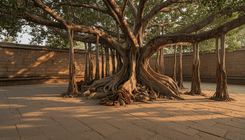
Dakshinamurti is Shiva as the silent teacher, the guru who teaches without words. In this form, Shiva sits beneath a banyan tree, his face turned to the south—dakshin means south in Sanskrit—and transmits knowledge through gestures, presence and the transmission of consciousness itself. If you have felt understanding dawn not from words but from being near someone who knows, you have glimpsed what Dakshinamurti offers.



The Form and What It Means
Dakshinamurti is shown sitting in a yogic posture, one foot resting on the demon Apasmara, who represents ignorance and forgetfulness. This posture is not a victory over evil in the way you might expect; rather, it shows that ignorance exists, but the guru stands above it. Around him sit four Kumaras—the four sons of Brahma—who represent different types of knowledge. They gaze at Shiva in wonder as he teaches them through silence.
His hands hold specific gestures. One hand makes the chin mudra, the gesture of knowledge, formed by joining the thumb and forefinger. Another holds a serpent or a small drum called a damaru. These objects carry meaning: the serpent represents kundalini energy and the coiled potential within consciousness, while the damaru symbolises the sound of creation and dissolution. None of these things are ornaments. Each one points to an aspect of the teaching that unfolds without needing to be said.
Why the Teaching is Silent
In the Upanishads, the oldest philosophical texts of Hinduism, knowledge of Brahman—ultimate reality—is described as something that cannot be fully captured in words. The Mandukya Upanishad speaks of Om, the primordial sound, which contains all knowledge but cannot be explained through ordinary language. This is the understanding that shapes the figure of Dakshinamurti. Words point towards truth, but they are not the truth itself.
The teaching happens through transmission of grace, what is called shaktipat or anugraha. A student sitting in the presence of the guru absorbs understanding at a level deeper than the mind. The Dakshinamurti Stotra, a hymn of 10 verses attributed to Adi Shankara, opens by saying that Dakshinamurti is known through silence alone. The text then uses words to gesture towards what cannot be said—a paradox that is deliberate and complete.
When you visit a temple and sit before the image of Dakshinamurti, the practice mirrors this principle. You are not expected to think about what the form means. You sit, you look, and you remain open. Understanding may come, or it may not; the point is to be present, just as the four Kumaras are present.
The Dakshinamurti Stotra and Its Teaching
The Dakshinamurti Stotra is perhaps the clearest entry into understanding this form of Shiva. Composed in Sanskrit by Adi Shankara, it is a meditation in verse rather than a logical argument. Each verse contemplates the teacher who dwells in silence, who is not found through seeking but recognised when seeking falls away.
The stotra describes the nature of consciousness itself: that what witnesses all experience, yet stands apart from it, is the same in you as it is in Shiva, as it is in all beings. The teaching is that you are not separate from what you seek. This insight cannot be gained through study alone; it must be lived and recognised. The silence of Dakshinamurti points to this recognition.
Many Hindu traditions use the Dakshinamurti Stotra in their daily practice. It is chanted as a way to receive his grace, not to request something specific, but to open oneself to the transmission that needs no words. Some practitioners recite it as meditation; others listen to it and let the words work on their mind and heart without trying to understand them intellectually.
Dakshinamurti in Temple and Practice
Temples dedicated to Dakshinamurti are found across South India, most notably in Tamil Nadu. The Dakshinamurti temple at Thillai in Chidambaram, where Shiva is shown dancing, also holds space for Dakshinamurti in a sanctum that honours the guru principle.
Worship of Dakshinamurti is part of many daily and ritual practices among Hindus who follow the Advaita Vedanta tradition, which emphasises non-dualism and the unity of Atman—the self—with Brahman. Devotees offer prayers to Dakshinamurti to receive clarity in their spiritual path, to remove confusion and obstacles, and to cultivate the attitude of a true student: receptive, humble and willing to learn.
Some traditions honour Dakshinamurti on Guru Purnima, the full moon day in the month of Ashadha, when gurus are honoured. Others maintain a regular practice of meditation or worship throughout the year. The practice is not about performing correct actions; it is about cultivating the inner condition in which teaching can be received.
The Inner Teacher
A core teaching that emerges from contemplating Dakshinamurti is that the guru principle is not confined to a person sitting across from you. Within each being is an inner teacher, a capacity to know what needs to be known when the conditions are right. Dakshinamurti represents this inner dimension of teaching.
This does not dismiss the value of a living teacher or the lineage of wisdom traditions. Rather, it clarifies that the deepest learning is not a transaction where information passes from one person to another. It is a recognition of what is already present, which a true teacher helps to awaken. The teacher and the teaching are one, and both are invitations to remember what you already are.
When you sit in silence before the image of Dakshinamurti, or when you recite the Dakshinamurti Stotra, you are not asking for something to be added to you. You are creating the conditions for something already present to be revealed. That is why his gesture is one of teaching, but his mouth is closed.
Common questions
Can I practice Dakshinamurti worship if I am not from a Hindu background?
The principles that Dakshinamurti represents—learning through silence, the transmission of wisdom beyond words, and the inner teacher—are universal. Many people from different backgrounds find meaning in meditating on this form or reciting the Dakshinamurti Stotra. What matters is genuine openness and respect for the tradition you are entering.
How often should I chant the Dakshinamurti Stotra?
There is no fixed rule. Some practitioners recite it daily as part of their practice, while others do so weekly or on special occasions like Guru Purnima. Begin with what feels sustainable—even once or twice a week with attention is more valuable than a hurried daily recitation. The quality of your presence matters more than frequency.
What is the difference between worshipping a guru and worshipping Dakshinamurti?
Worshipping a living guru involves relationship, guidance and specific teachings from that person. Dakshinamurti represents the guru principle itself—the capacity to teach and awaken understanding that exists within all beings and beyond any single form. You can honour both: a living teacher may even point you towards this understanding of Dakshinamurti.

Related Articles


