
Chyawanprash: The Origin Story of Sage Chyavana's Herbal Remedy
Ancient wisdom in a healing jam

Sunil Chaurasia
14 Nov 2026 • 6min
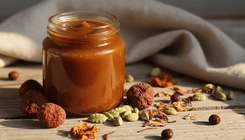
Chyawanprash is a thick herbal jam that has been made and used in Indian homes for thousands of years. Its name comes from an ancient story about a sage named Chyavana, whose two wives asked the twin physicians of the gods to restore his youth. The remedy they created—a mixture of over 40 herbs and spices, led by the fruit of the amalaki tree—became what we now call chyawanprash. This article tells you where chyawanprash comes from, what makes it, and why it became one of Ayurveda's most enduring formulas.



The Tale of Sage Chyavana
The story of chyawanprash begins in the Mahabharata, one of the two great epics of Hinduism. Chyavana was an old rishi, a spiritual teacher, who had lived for many years in deep meditative practice. His wives were the twin daughters of a king. One day, Indra, the king of the gods, came to test Chyavana's vow of fidelity. Indra appeared before the wives in the form of their husband, but they saw through his disguise and remained true.
When Indra retreated and revealed himself, he was impressed by the sage's household. But he also noticed that Chyavana was very old. The sage's wives approached the Ashwini Kumaras—the twin physicians of the gods—and asked them to restore their husband's youth and vigour. The Ashwini Kumaras, pleased by the devotion shown to them, created a special herbal preparation. They fed Chyavana this remedy, and he regained his youth, strength and vitality. From that moment, the formula became known as chyawanprash: the jam (prash) of Chyavana.
What Chyawanprash Is Made From
Chyawanprash is made from a base of amalaki fruit, also known as Indian gooseberry, combined with dozens of other herbs and plant materials. The amalaki is the heart of the formula, prized for its high content of vitamin C and its ability to nourish and rejuvenate the body. Around this central ingredient, traditional recipes include sesame oil, honey, ghee, and spices such as cardamom, cinnamon, nutmeg and long pepper.
Many formulas also contain herbs from the ashtavarga, a group of eight plants that are considered particularly difficult to obtain but highly potent in Ayurveda. These eight plants are shatavari, ashwagandha, bala, gokshura, mudgaparni, mashaparni, patala and kakanasa. Different makers add different numbers and combinations of plants, and regional variations in the formula exist across India, but the structure remains the same: a concentrated paste of fruits, oils, herbs and spices, designed to balance all three doshas and strengthen the body over time.
Why Ayurveda Valued This Formula
In Ayurvedic medicine, chyawanprash came to be valued as a rasayana: a rejuvenating remedy that supports longevity and resilience. The word rasayana means "the path of rasa", where rasa refers to the nutritive essence that nourishes all tissues of the body. A rasayana is not meant to treat a specific illness, but rather to strengthen the whole system and build resistance to disease.
Chyawanprash works in several ways within Ayurvedic theory. Its warming spices help kindle digestive fire, allowing the body to absorb and assimilate the nourishment from food. Its oils and ghee lubricate the tissues and calm vata, the force of movement and change. Its sour taste from the amalaki stimulates the liver and supports detoxification. The combination of herbs addresses all three constitutions: kapha, pitta and vata. This broad action is one reason the formula has survived in continuous use for over two thousand years.
How Chyawanprash Moved Into Homes
What began as a divine gift to a single household gradually became part of Indian household medicine. By the time the great Ayurvedic texts were compiled—particularly the Charaka Samhita—chyawanprash was already established as a standard formula. Ayurvedic physicians made and prescribed it for their patients, and families learned to prepare it in their own kitchens. Over centuries, it became not just a medicine but a cultural practice: a jar of chyawanprash in the home meant you had access to a trusted remedy for the seasons when immunity tends to drop.
The formula proved resilient across India's many regions and Ayurvedic traditions. Each area developed its own version, adjusting ingredients to local plants and climates. In southern India, the formula might emphasize different herbs than in the north. Some preparations were sweeter, others more warming. Yet the core remained the same: amalaki as the foundation, supported by a constellation of herbs designed to restore and maintain health.
The Science Behind the Story
Today, the amalaki fruit at the heart of chyawanprash has been studied by researchers for its nutritional content and effects on health. These studies confirm what Ayurvedic physicians have long known: that amalaki is remarkably rich in vitamin C, contains compounds with antioxidant properties, and can support immune function and tissue repair. This does not prove the Chyavana story is literally true, but it does show that the formula created by that story is grounded in real plant action. The legend led practitioners to a remedy that works.
Chyawanprash Today
Chyawanprash is now sold commercially across India and by Ayurvedic companies worldwide. You can buy it ready-made, or learn to prepare it at home from traditional recipes. Many people take a spoonful every morning during the autumn and winter months, when the body tends to weaken and respiratory issues become more common. Some use it year-round as a daily supplement. The formula has changed little in substance over two millennia: it remains a mixture of the same amalaki, oils, honey and herbs that the Ashwini Kumaras are said to have offered to Chyavana.
What has changed is how we understand its place. Chyawanprash is no longer only a medicine in the classical sense. It is a bridge between the worlds of myth and health, a daily reminder that the old stories of Indian medicine are not separate from its practical results. When you take a spoonful of chyawanprash, you are following a practice described in one of the world's oldest written sources, using ingredients that science has begun to verify, guided by a philosophy of health that values the whole person. That is why this single formula has endured.
Common questions
Is chyawanprash mentioned in any ancient Ayurvedic texts?
Yes, chyawanprash is described in the Charaka Samhita, one of the foundational texts of Ayurveda. It is classified as a rasayana, a rejuvenating formula meant to strengthen the whole system and support longevity rather than treat a specific disease.
How many herbs are typically in chyawanprash?
Traditional recipes contain over 40 herbs and plant materials, though the exact number and combinations vary between makers and regions. The amalaki fruit forms the base, and many formulas include herbs from the ashtavarga, a group of eight particularly potent plants in Ayurveda.
When is the best time to take chyawanprash?
Many people take chyawanprash during autumn and winter months when the body tends to weaken and respiratory issues become more common. Some use it year-round as a daily supplement, typically taking a spoonful in the morning.

Related Articles


