
Camphor in Puja: Why It Burns Without a Trace
The Light of Pure Consciousness

Sunil Chaurasia
14 Nov 2026 • 6min
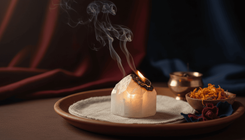
When you light camphor in puja, it burns with a bright white flame, burns intensely, and then disappears entirely—leaving no ash, no smoke, no residue. This is why camphor is burned in almost every Hindu ritual: it is not just a fragrant plant, but a living symbol of something the tradition considers essential to worship. The complete disappearance of the camphor teaches what the puja is meant to do: purify and dissolve the ego until only pure consciousness remains.



The Physical Nature of Camphor
Camphor—called kapoor in Hindi—is the purified crystalline compound extracted from the camphor tree, which grows in East Asia and Southeast Asia. In its pure form, camphor is unusual: it is solid at room temperature, but it vaporizes readily when heated, turning directly into smoke and gas without becoming liquid. This property—sublimation, as chemists call it—is what makes it burn so completely and leave no ash.
This physical completeness is not accidental to its use in puja. The ritual deliberately chooses the substance because what the eye sees is the whole process: the solid becomes light, warmth, and fragrance, and then it is gone. There is nothing left to carry away, nothing material remaining to be worshipped or kept. The worship itself, the act of offering, is the only thing that stays.
Symbolism in Hindu Tradition
In Hindu philosophy, the complete burning of camphor stands for the dissolution of individual ego into the infinite consciousness that the puja approaches. Just as the camphor leaves no trace of itself behind, the ritual intention is that the self—with all its desires, attachments, and sense of separation—should dissolve into the universal Self, or Atman.
The light of the camphor flame is also understood as the light of consciousness itself, or chit-prakash. In many pujas, particularly aarti—the circular movement of the flame before the deity—the camphor is used to carry this light toward the murti (the form or image of the deity). By offering the light of camphor, the worshipper offers the light of awareness, not something material that remains after the ritual is done. Some sampradayas, or traditions, understand the flame as the burning away of karmic impressions; others see it as the fire of knowledge that illuminates the path toward liberation.
Camphor in Daily and Festival Worship
Camphor appears in many forms of puja and is not reserved for grand ceremonies. In home worship, camphor is commonly burned during aarti, when the flame is moved in a circular pattern before the deity. It is lit during puja in temples and household shrines, and it is especially important during major festivals and rituals. The fragrance of camphor is considered purifying to the space and pleasing to the deities.
The scale and formality of the use differs. In a simple daily puja at home, a small piece of camphor may be lit as part of the offering. In larger temple rituals or celebrations, more substantial amounts might be used, and the camphor may be mixed with other fragrant substances. The aarti itself can be performed with just camphor, or the flame may be accompanied by burning ghee lamps or other elements depending on the tradition and the occasion. In all cases, the principle is the same: the substance that burns without remainder is the chosen offering.
What Camphor Teaches the Worshipper
The practice of burning camphor is not merely symbolic; it is meant to instruct the worshipper through direct observation. By watching the camphor burn completely away, you are seeing a teaching about impermanence and the nature of the self. The ritual is reminding you that everything material—including the body and the individual ego—is temporary, and that what remains is only pure awareness.
This is particularly important in a tradition like Hinduism, which holds that most suffering comes from the belief that the self is separate, permanent, and the most important thing. By repeatedly witnessing and participating in the offering of something that disappears completely, you begin to understand this principle not just as an idea, but as a lived experience. The puja is teaching you to let go, to trust in what you cannot see or hold.
Some practitioners also understand the burning of camphor as a form of tapasya, or austerity: the complete surrender of something of value, with nothing held back and nothing expected in return. In this sense, every time you light camphor in puja, you are practicing non-attachment and offering yourself as the camphor offers itself—completely and without reserve.
Camphor and Other Sacred Materials
In the context of Hindu ritual, camphor is often used alongside other sacred substances, each with its own meaning. Incense, such as sandalwood or agarbatti, produces lingering smoke and fragrance; this is often understood as the offering that carries prayers toward the divine, or the spreading of blessing through the space. Ghee lamps, or diyas, burn steadily and produce ash, representing the eternal flame of consciousness; but this flame is contained, whereas the camphor's flame rises and vanishes.
The deliberate use of camphor alongside other offerings teaches that different substances carry different meanings. The combination creates a complete ritual language: the steady ghee lamp speaks of enduring consciousness; the sandalwood incense carries the prayer; the camphor speaks of ego-dissolution and the return to the source. Together, they form a teaching for the senses and the mind.
A Practice of Remembrance
Burning camphor in puja is ultimately a practice of remembrance. Each time the camphor burns away completely, it reminds you of the central truth the tradition wishes to transmit: that your deepest nature is not the small self that believes it is separate, but the infinite consciousness within and beyond everything. This is why camphor remains one of the oldest and most universal offerings in Hindu worship.
When you light camphor in puja, you are not simply following a custom. You are participating in a ritual that has carried the same teaching for centuries, using a substance that, through its nature, teaches what words alone cannot teach as clearly.
Common questions
Why does camphor burn completely without leaving ash?
Camphor is a pure crystalline compound that sublimates—turning directly from solid into gas and vapor when heated—rather than burning to ash like other materials. This physical property makes it unique among ritual offerings and is deliberately chosen because it symbolizes the complete dissolution of the ego.
Is camphor burned the same way in all pujas?
No. In simple home puja, a small piece may be lit as an offering. In temple rituals or festivals, larger amounts may be used, and camphor may be mixed with ghee or other substances. The principle remains the same, but the scale and formality vary by tradition, occasion, and the sampradaya being followed.
Can I use artificial camphor in puja?
Traditional worship uses natural camphor, which sublimates completely. Artificial or synthetic camphor may not burn in the same way and does not carry the same significance. For authentic practice, natural camphor from the camphor tree is preferred.

Related Articles


