
Bali Pratipada and the Promise of Lord Vishnu to King Mahabali
When a righteous demon gave all he had, and the Lord granted his wish

Aditya Pandey
02 Nov 2026 • 6min
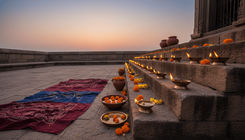
The Bali Pratipada story centres on the day when Lord Vishnu, in his avatar as the dwarf sage Vamana, met a righteous demon king and made him a promise that changed the worlds. This encounter forms the heart of a festival that is still celebrated across India today, particularly in parts of southern and western India, where the day marks the beginning of a new season and a new calendar year.



Who was King Mahabali
Mahabali was a powerful asura—a being often called a demon in English, though the word carries a different sense in Sanskrit texts. He was not evil by nature but ambitious and increasingly prideful. Through tapasya, the practice of rigorous self-discipline and meditation, he had gained great strength. He performed complex rituals and won the blessing of Brahma, the creator god, which gave him extraordinary powers. Mahabali ruled his kingdom with justice and generosity, and his subjects loved him. Yet over time his confidence grew into arrogance. He began to believe that no power in the three worlds—heaven, earth and the underworld—could match his own.
This growing pride eventually threatened the order of creation itself. The devas, the gods who maintain cosmic balance, found their authority slipping. They appealed to Vishnu, who preserves and protects the universe, to intervene.
The Avatar of Vamana
Vishnu decided to take a form suited to the moment: Vamana, a dwarf sage. A sage is a figure of spiritual authority—someone whose wisdom commands respect regardless of physical size or apparent power. Vamana appeared as a young brahmin boy, small in stature but radiant with an inner light that those with spiritual perception could recognize.
Vamana approached Mahabali's court during a great yajna, a ritual sacrifice, at which the king was giving away wealth and granting boons to all who asked. Mahabali was in his element: this was the moment to display his generosity and power. When the small figure arrived, the king received him with warmth and promised to grant him any wish.
Vamana asked only for three paces of land, measured by his own steps. This seemed a modest request—almost insulting in its smallness. Yet Mahabali, true to his word and bound by the sacred oath of a yajna, agreed.
The Three Paces
What followed was the revelation of Vamana's true nature. The dwarf began to expand, growing to cosmic proportions. With his first step, Vamana covered the entire earth. With his second, he covered the heavens. The sky itself seemed to contract beneath his stride. For his third step, there was no space left in either world. Mahabali, realizing what had happened and understanding the moment's gravity, bowed before the Lord and offered his own body as the final pace.
Vishnu, pleased by Mahabali's humility and surrender, granted him a boon. Though Mahabali had lost his dominion over the three worlds, he would be blessed with something more lasting: the Lord promised to visit him once every year. From that time forward, Vishnu would descend to the earthly realm to spend time with this noble asura who, in his moment of greatest loss, had shown true devotion.
Why the Festival Matters
Bali Pratipada—literally the first day after Bali—commemorates this encounter. The festival celebrates not the victory of the gods over a demon, but rather the meeting of divine wisdom and human humility. In regions where it is observed, the day marks the beginning of a new calendar year. The name "Pratipada" means the first lunar day, specifically the first day of the bright fortnight of a lunar month, usually falling in the months of October or November in the Gregorian calendar.
The festival carries deeper meanings. It is a reminder that genuine power lies not in force or pride, but in the willingness to surrender and serve. Mahabali's story shows that even a being of great achievement and strength can find peace and lasting blessing through humility. For those who celebrate, Bali Pratipada is a time to reflect on the qualities that the Lord values: truth, generosity, and the grace that comes when we acknowledge something greater than ourselves.
The Promise Continues
In some traditions, it is believed that Mahabali visits his former kingdom once a year on this very day, invisibly checking on his beloved subjects. The festival becomes a way for people to welcome him and maintain the connection he holds with the earth. Oil lamps are lit, new clothes are worn, and homes are prepared—not only as celebration but as an act of remembrance and respect.
This story also teaches about the nature of divine play, or lila, in Hindu philosophy. The Lord does not act from anger or the need to punish. Instead, Vishnu appeared as Vamana to restore balance and, in doing so, elevated Mahabali beyond his own understanding. What seemed like defeat became the beginning of a blessed state. The demon king's promise of an annual visit transformed him into a figure of reverence, almost a presence watched for and welcomed each year.
The Bali Pratipada story reminds us that humility in the face of the divine brings its own rewards, and that true greatness is measured not by what we conquer but by what we are willing to release.
Common questions
Is Bali Pratipada celebrated the same day everywhere in India?
Bali Pratipada is primarily observed in Kerala, Maharashtra, Karnataka and parts of Goa and Rajasthan. In Kerala it is known as Onam and is marked as a major harvest festival with elaborate celebrations. The date varies slightly each year according to the lunar calendar.
What does Vamana mean and why did Vishnu take that form?
Vamana means dwarf. Vishnu chose this form because a small, humble appearance conceals divine power and wisdom, and it demonstrated that true strength is not measured by physical size. The form allowed Vishnu to teach through his actions rather than through force.
What happened to Mahabali after he surrendered?
After surrendering to Vishnu, Mahabali was granted a boon: he would receive the Lord's blessing and visit from Vishnu once every year. This transformed him into a figure of spiritual importance, and in many traditions he is now remembered as a righteous soul who was elevated through his humility and devotion.

Related Articles


