
Ayodhya Deepotsav: How the City Celebrates Rama's Return
Lamps, faith and a city transformed

Abhilash Ramakrishna
13 Nov 2026 • 7min
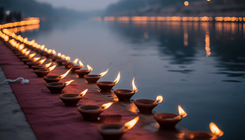
Ayodhya Deepotsav is the way Ayodhya, a city in Uttar Pradesh with deep roots in the Ramayana, marks Diwali. The word deepotsav means festival of lamps, and in Ayodhya it refers not just to the day itself but to a celebration that draws thousands of visitors to light millions of lamps across the city. The practice sits at the intersection of two traditions: the story of Rama's return from exile, which Diwali commemorates across India, and Ayodhya's own identity as the place where that return happened.
The Ramayana tells that after fourteen years of exile, Rama returned to Ayodhya with his wife Sita and brother Lakshman. The people of the city, overjoyed, lit lamps throughout the streets to welcome him home and light his path. This act of illumination became the root of how Diwali is celebrated: a festival of light to mark the triumph of dharma, or righteous living, over adharma, or its absence. But in Ayodhya itself, the celebration carries a particular weight and specificity. It is not an abstract commemoration of an ancient story; it is the city honouring its own history and its place in that story.



The Story Behind the Celebration
The Ramayana, whether in the Sanskrit text attributed to Valmiki or in regional versions like Tulsidas's Ramcharitmanas in Hindi, tells the narrative that grounds Ayodhya Deepotsav. Rama, the eldest son of King Dasharatha, was set to be crowned king when a promise made long ago forced him into exile instead. He went willingly, and with him went Sita and Lakshman. The exile lasted fourteen years, during which Sita was abducted by the demon Ravana, and Rama had to wage war to bring her home. When Rama finally returned victorious to Ayodhya, the people celebrated not only his homecoming but the restoration of righteous rule to the kingdom.
That return is the moment Diwali marks. Across India, families light lamps, set off fireworks, and exchange sweets to honour the occasion. But in Ayodhya, the city itself becomes the site of the celebration. The streets where Rama walked, the river where he bathed, the city that waited for him—these places are lit up in his remembrance. The deepotsav has become the city's way of reliving that homecoming year after year.
What Ayodhya Deepotsav Looks Like
The Ayodhya Deepotsav, in its modern form, unfolds over several days around Diwali. The most visible expression is the mass lighting of oil lamps, called diyas. Hundreds of thousands, even millions of diyas are lit across the city—along the banks of the Sarayu River, in temples, on the ghats, and throughout residential and commercial areas. The sight of so many small flames against the darkening sky creates an atmosphere of collective devotion and remembrance.
The celebration also includes religious rituals. Aarti, the waving of lamps before a deity, takes place in temples throughout Ayodhya. People recite passages from the Ramayana, particularly those describing Rama's exile and return. The Hanuman Garhi temple and the Ram Mandir are focal points of the observance, drawing pilgrims who come to mark the occasion with prayer and reflection.
The deepotsav has also become a cultural event that draws visitors from across India and beyond. The lighting of lamps has been coordinated as a public spectacle in recent years, with organized gatherings, cultural programmes, and the participation of large numbers of people gathered specifically for the event. This blend of religious observance and public celebration reflects the way Ayodhya's identity as a pilgrimage city intersects with its role as a city of historical and cultural significance in the life of millions of Hindus.
Regional and Sampradaya Variations
While Diwali is celebrated across India, the forms that celebration takes vary by region and by the traditions, or sampradayas, to which people belong. In Ayodhya, the deepotsav is distinctive because it ties Diwali explicitly to the Ramayana narrative and to the city's geography. Other cities and regions may emphasize different aspects of the festival: the victory of Krishna over the demon Narakasura in some parts of South India, the return from the churning of the ocean in others, or simply the triumph of light over darkness as a universal theme.
In Ayodhya itself, there are variations in how different groups and communities observe the day. Some families light diyas at home and offer prayers in family temples. Others gather at public ghats or temples for collective aarti and ritual. The Ramcharitmanas recitation is part of many observances, while others focus on the Valmiki Ramayana. These variations reflect the diversity of practice within a single tradition: the core is shared, but the expression is personal and communal both.
The Significance of Light and Return
The lighting of lamps carries layers of meaning in Hindu practice. Light symbolizes knowledge, consciousness, and the dispelling of ignorance. In the context of Rama's return, it represents the restoration of righteous rule and the victory of good over evil. But it also speaks to something more intimate: the desire to illuminate the path home, to welcome the beloved, to mark a moment of change and renewal.
The return itself—Rama's return to Ayodhya, a person's return to their home after a long absence, the return of light after the darkness of winter, the cyclical return of seasons and of time itself—is a theme that resonates across Hindu thought and practice. Diwali, celebrated as a festival of return, draws on this resonance. In Ayodhya, where the most celebrated return in the Ramayana took place, that symbolism becomes concrete and localized.
The deepotsav is also a way of keeping the Ramayana alive in the present. It is not a historical reenactment or a museum piece, but a living practice through which a city and its people sustain a connection to a sacred story. When someone lights a lamp in Ayodhya on Diwali, they are participating in a chain of remembrance that stretches back through centuries, and they are affirming the values—loyalty, righteousness, devotion—that the Ramayana teaches.
Visiting or Observing Ayodhya Deepotsav
If you are in Ayodhya for Diwali, or if you observe the festival elsewhere but want to connect it to the deepotsav tradition, there are several ways to participate. Lighting a lamp at home and reflecting on the story of Rama's return brings the celebration into your own practice. Reading passages from the Ramayana, particularly the books describing the exile and return, can deepen your understanding of the narrative that grounds the festival.
If you are visiting Ayodhya itself during Diwali, the city's temples and ghats welcome visitors. The experience of seeing thousands of lamps lit together, of participating in collective prayer and aarti, of walking the streets of a city so visibly transformed by light and devotion, offers a direct encounter with a tradition that is both ancient and living. The deepotsav is an invitation to understand Diwali not just as a festival of lights, but as a celebration rooted in a particular story, place, and people.
Common questions
What is the exact date of Ayodhya Deepotsav?
Ayodhya Deepotsav is celebrated on Diwali, which falls on different calendar dates each year because it follows the lunar calendar. Diwali is observed on the new moon day in the month of Kartik, typically between mid-October and mid-November.
How many lamps are lit during Ayodhya Deepotsav?
The number of lamps lit has grown over the years as the celebration has become more organized. In recent large-scale events, organizers have coordinated the lighting of hundreds of thousands to millions of diyas across the city, though the exact number varies annually.
Can anyone visit Ayodhya to celebrate Deepotsav?
Yes, Ayodhya welcomes visitors from all backgrounds during Diwali. The temples and ghats are open to visitors, and the celebration of lighting lamps is an inclusive practice. However, the scale of the event and large crowds during peak times mean planning ahead for accommodation and travel is wise.

Related Articles


