
Abhimanyu and the Chakravyuha: His Greatest Challenge
A warrior's last stand in the spiral battle formation

Aditya Pandey
28 Oct 2026 • 6min
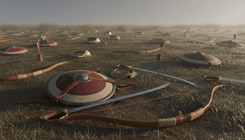
Abhimanyu's greatest challenge was not merely to survive the chakravyuha, the spiral battle formation that killed him, but to act alone against impossible odds without the guidance or support of any other warrior. The chakravyuha represents one of the most devastating military formations in ancient Indian warfare, designed so that once you enter it, the paths spiral inward in such a way that those caught inside cannot easily escape. Abhimanyu entered this formation on the thirteenth day of the Kurukshetra war, not by choice, but because the Pandava forces needed to penetrate the enemy lines. His youth—he was only in his mid-teens—his courage, and his incomplete knowledge of how to navigate the formation created a perfect tragedy.



The Chakravyuha and Its Design
The chakravyuha is sometimes called a labyrinth of battle, a formation that mirrors the structure of a wheel or spiral. Those who designed military strategy knew that once warriors entered this formation, they would face an impossible geometry of enemy forces. Each layer of the spiral brought new groups of opponents, and the way the formation was built meant that escape was nearly as difficult as entry. Breaking into the chakravyuha required both skill and strength, but the real danger lay inside, where every path seemed to lead deeper into the circle rather than outward.
In the Mahabharata, Drona, the Kaurava forces' supreme commander, devised the chakravyuha specifically because he understood the strengths of the Pandava army. He knew that direct combat would be costly, so he created a formation that would trap and isolate individual warriors. The spiral design meant that even if warriors tried to fight their way back out, they would be fighting on multiple fronts, with fresh enemy soldiers constantly replacing those who fell. This was strategy that turned the battlefield itself into a weapon.
Why Abhimanyu Alone Could Penetrate It
Abhimanyu had learned the secrets of entering the chakravyuha from his father Arjuna while still in the womb. Arjuna had once explained to his wife Subhadra how to break into such a formation, and the unborn Abhimanyu had absorbed this knowledge. This prenatal teaching gave him knowledge that no other warrior possessed. When the Pandava generals saw an opening to break through the Kaurava lines on that thirteenth day of the war, they realised that only Abhimanyu could do it. His mother Subhadra had not told him the rest of the story—how to exit the formation—because Arjuna's explanation had been interrupted before he reached that part.
This incomplete knowledge was Abhimanyu's defining curse. He entered the chakravyuha with confidence and skill, knowing exactly how to pierce the spiral's outer layers. But once inside, he was trapped by his own limitations. He did not know the way out. Every warrior who might have followed him and learned the exit route alongside him was kept outside the formation by the Kauravas' defensive strategy. Abhimanyu was forced to fight his way through layer after layer, exhausting his strength against fresh opponents who surrounded him on all sides.
The Isolation and the Fight
Abhimanyu's isolation inside the chakravyuha is the heart of his tragedy. The greatest warriors of the Pandava side—Arjuna, Krishna, Bhima, Nakula and Sahadeva—were all being held elsewhere on the battlefield by other Kaurava commanders. This was deliberate strategy by Drona and the Kaurava generals. Even Arjuna, Abhimanyu's father, could not reach him in time to help. Abhimanyu fought alone against the entire Kaurava army, with no one to advise him, no one to fight alongside him, and no one who understood his predicament well enough to help him escape.
A young warrior, skilled but not yet at his full power, he faced Shakuni, Dushasana, Karna, Drona and eventually Jayadratha. The Kauravas had sworn that no one would help Abhimanyu escape, and they held their oath with ruthless discipline. Each opponent who faced him was either an older, more experienced warrior or one of the kingdom's greatest fighters. Abhimanyu's weapons grew lighter as he fought, his strength drained by the endless combat, his options narrowed by the formation that contained him. He remained defiant—he continued to fight rather than surrender—but he was fighting a battle with no path to victory and no exit.
The Moment of His Death
On the thirteenth day of the war, as Abhimanyu fought inside the chakravyuha, he reached a point where he could no longer withstand the combined assault. Different versions of the Mahabharata record his death differently. Some accounts describe Jayadratha dealing the final blow; others name multiple assassins. What all accounts agree on is that he was surrounded and overwhelmed. When Arjuna learned of his son's death, his grief and rage became a force of nature. He swore to kill Jayadratha before the sun set that day, and he kept that oath, but by then Abhimanyu was already gone.
Abhimanyu's death became a turning point in the war. It was the moment when the Pandavas' sense of proportion and dharma began to erode. In seeking revenge for Abhimanyu's death, they committed acts that would haunt them for the rest of their lives. The chakravyuha had claimed a warrior who had done nothing to deserve death; it had trapped him in a situation where honour, courage and skill were not enough to survive.
What Made It His Greatest Challenge
Abhimanyu's challenge was not simply military but philosophical. He faced a test that had no solution within the rules he was supposed to follow. He could not dishonour himself by fleeing or surrendering; he was Arjuna's son and a warrior of the Yadava line. Yet honour and courage alone could not save him. The chakravyuha was designed precisely to exploit such a situation—to trap a skilled and brave warrior in a space where those virtues would lead only to exhaustion and death.
His greatest challenge was to maintain his dharma, his duty as a warrior, knowing that doing so would likely kill him. He faced the knowledge that even perfect skill and perfect courage might not be enough. He had to choose whether to enter the formation at all, knowing he did not know the way out. He chose to enter. That choice, made in service of his army and his family, is what makes his story resonate across generations. His was the challenge of incomplete knowledge, overwhelming odds, and the impossible choice between duty and survival.
Common questions
How old was Abhimanyu when he entered the chakravyuha?
Abhimanyu was in his mid-teens, still very young compared to the experienced warriors he faced inside the formation. His youth meant he had power and skill but not yet the decades of battle experience that warriors like Drona, Karna and Jayadratha possessed.
Who killed Abhimanyu in the chakravyuha?
Different versions of the Mahabharata record his death differently. Some name Jayadratha as dealing the final blow, while others describe multiple warriors contributing to his death. All accounts agree he was surrounded and overwhelmed by the combined forces.
Why didn't Arjuna come to save his son?
Arjuna was deliberately held elsewhere on the battlefield by other Kaurava commanders. Drona and the Kaurava generals had orchestrated the battle so that the strongest Pandava warriors could not reach Abhimanyu or follow him into the chakravyuha.

Related Articles


